Sunday, 3 April 2022

Transient Towpath Trudging - Pt. 7

The 'Big One' was certainly less well attended by some of the bigger manufacturers this year with Korum and Dynamite baits the stands I would quite happily hand over some of my hard earned cash to.

Still enough to go at and NGT for example has a cracking sale on and I got through the money I'd set aside rather quickly. Sam, Carrot-Man and I didn't hang around for the speakers this time so a few hours we were done and dusted.

I do like to get hands on with rods and Freespirit for example had their full range for all to see and there is a certain rod that may well be added to ones armoury. They seem to have a nice range now and not overly expensive compared to some rods these days. 

One of my favourite rods a TFG River and Stream was built on a Freespirit blank and for a chub rod I cannot think of another rod I'd replace it with, it is just one of those rods that suits the quarry perfectly.


Now what didn't suit the quarry perfectly was the -4 degrees that greeted me when I headed down to an area of canal that I haven't fished for ages.

I've caught Zander here in the past so a deadbait rod and I'd also have a float set-up where I'd fish maggots with some liquidised bread as visual groundbait. The water temperature had plummeted over the last 48 hours and even I didn't think it would be as low as 6.8 degrees. 

Still plenty to go at here and it's one of those stretches that can offer plenty of bites from silvers if you can get them feeding. 


Could I get them feeding, errrr no....!!!!

....there was lack of fish topping as well which didn't bode well.

Now I got bored with the lack of bites so went on the rove and basically fished three swims with the same result. The Zander rod, fair enough was unhindered but I was surprised that even the small roach and the bream failed to show. The morning was pleasant though and when the sun rose and warmed the face I was glad I made the effort to get out and fish. 


Even the area of thick cover that often throws up a bite or three the deadbait didn't get any interest whatsoever. 

It's surprising just how Zander can switch off in these conditions though so unless you can drop the bait directly on their heads like I found out for this session, as I found out you'd be staring at a blank. So not unexpected to be honest but a very quiet morning indeed. 


So I decided to end the session early and the frost was still hanging around when I left at 10.30am. 

We are in to April and it should be the prefect time of year to fish the canals for all manner of species but this was one of those mornings where I could have predicted the outcome. Let's hope that cold snap is the last one till next winter but the weather does seem to be all over the shop at the minute so who knows, it may well be wishful thinking !!!!

Saturday, 2 April 2022

Brook Trout - Warwickshire Tenkara Pt.1

Canal fishing has always been a means to an end for me because lets be honest, flowing waters is where ones allegiances lie and every countdown to the closed season, the chin scratching starts and I'm wondering what the heck I'm going to fish for. 

I'm not a huge fan of still waters either as I'm not one for sitting for any length of time and ok, I could maybe lure fish some bigger lakes or floater fishing for carp that sort of thing, but the reality is, they are just not for me. 


Obviously the Canal Zander Quest that took me 6 years to complete really was a welcome distraction when the rivers are out of bounds, but the capture of the 11lb 8ounce monster really did come out of the blue and that chapter in ones fishing was closed with a rather loud thud. 

Walking the towpaths you get to see not only nice countryside which is a nice distraction from looking down to avoid the dog landmines but from time to time flowing water fishing spots are stumbled upon and the other day an explore of an adjacent gin clear brook really did look good for a trout bite. 


Now I've caught plenty of brown trout in Warwickshire but not on a dry fly and it got me thinking about dusting off my Tenkra rod and rigging it up properly with a fly set-up and remove the tiny float that I used to catch 'ickle fishes'

Now Tenkara is the modern Japanese version of the earliest fly fishing. People have been fly fishing for thousands of years. And for thousands of years, a rod, a line and a fly were all they had - and all they needed.


The fly reel is a relatively modern invention, and it offers a significant advantage - holding extra line so a fisherman can make long casts and a hooked fish can make long runs. With every advance, though, something gets left behind.

In fly fishing, what got left behind was the ability to get drag-free drifts in tricky currents by keeping a light line off the water's surface. Also, the direct connection between the angler and the fish was lost when fish started pulling against the drag instead of the rod. In Japan, Tenkara has been used for hundreds of years to fish in small, high gradient mountain streams. For small mountain streams, it really is an ideal way to fish. 

You don't make long casts and the fish don't make long runs, so you don't need a reel. There are cross currents everywhere and the long rod and light line make it much easier to get a drag-free drift or to keep a fly in an eddy. Because the line is off the water's surface, there is no need to mend. There is no excess fly line to get caught underfoot or get tangled in sticks and snags.

That lack of excess line to manage makes this the easiest way for a beginner to learn fly fishing. It is really pretty intuitive and a complete beginner can pick it up without having to take casting lessons.


In Tenkara fishing, the whole emphasis is on the fishing rather than the fly choice, on presentation rather than imitation. Matching the hatch is not emphasized. Interestingly, in Europe, which has an even longer tradition of fishing with a long rod and line tied to the rod tip, flies have been tied to match specific insects for almost 2000 years.

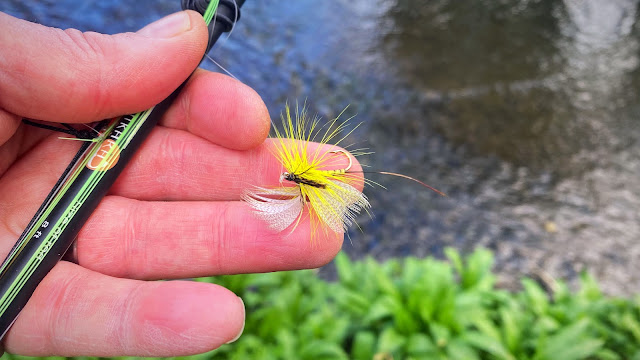
So anyway a quick search on Ebay I purchased some green Drake Fanwing mayfly dry flies, mainly because they looked good and were, well cheap !!! I also had some bread flake imitation flies I bought ages ago which were far smaller than I thought when they turned up, but I'm sure they would certainly attract a trout. 


I had to buy a yellow fluorocarbon level leader as well before adding the clear fluorocarbon leader which I already had. Tenkara is in essence all about the ability of keeping a line off the water and making the fly behave like a fly and the level line is by far the best way of doing this. 

There are some limits to a fluorocarbon level line and primarily this comes down to the wind. The lighter the line the less effective it becomes when trying to combat the wind.


Fluorocarbon lines tend to be invisible and trying to cast an invisible line can be a nightmare! so this yellow line looked ideal to at least see where the heck the fly was likely to be. 

Now this was a reccy mission but it would be rude not to cast a fly but when I got to the waterway not only was it gin clear as expected but it looked like someone had removed the plughole. Probably a month early I know but put the work in now it might help when the trout are looking skyward. 


It is surprising just how these brooks can change in appearance and flow in such a short distance. Often it is when there is a feeder stream helps boost levels and static swims can change to flowing ones in a hop skip and a jump. 

A couple of the swims were a couple of foot deep but oddly were fishless and apart from seeing a couple of small trout (3 inches) that shot out from their lair when I approached there was nothing doing at all. 


A schoolboy error fishing in bright sunshine and before the hatch but still it ticked a few boxed and fishing is all about learning.

Now this little brook takes a completely different appearance with a bit of water on and that's when I'll give it another go and maybe I'll wait to till warms up a bit and the insects make an appearance.  A blank, still, despite the cold weather the sun was pleasant and the Fitbit happy. 

Friday, 1 April 2022

The Abacus Feeder Rest & Fish Counter

Banks calculating interest, kids dividing up cookies, engineers designing bridges, we make calculations every day, and for as long as we’ve juggled numbers greater than our fingers and toes, we’ve sought aids to make computations easy and accurate.

For those F1 ten a penny fish counters and device clickers fishing a feeder match at the Engine pool at Earlswood Lakes can quickly get in to trouble using what is currently on the market today. 


A tally totalling tool is great for keeping track of your weight when net limits apply and could well avoid any possible disqualification issues. Now not long ago an angler banked a staggering 881lb 5oz of fish in five hours to smash the match on Bowes Lake at County Durham’s Angel of the North Fishing Lakes. 

He landed a never-ending stream of carp averaging 10lb to fill 20 keepnets come the final whistle, comfortably clear of the second placer angler, who landed an almighty 606lb of fish himself.
 
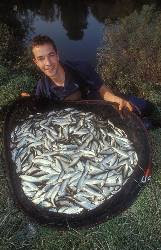
10 keepnets, yeap, a common occurrence !!!! > 2000 bleak in a match, yeap that happens too....

But wait no further there is a now a new option on the market from Piscatorial Quagswagging that stands out from the humdrum, so lets get back to basics for some answers. 

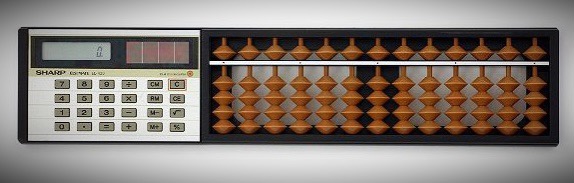
For centuries, calculators were the only machines to help us compute. A long lineage of devices stretching from the ancient abacus to today’s digital computer. 

Throughout the history of calculating we’ve devised ways to add speed and accuracy while subtracting the drudgery. Many solutions used body parts, notably fingers. A 19th century Chinese technique can count to 10 billion using just two hands! 

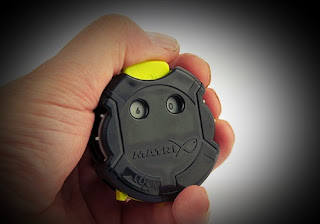
Matrix Fish Clicker
Other solutions were mechanical both general-purpose tools for everyday calculations and specialized instruments for engineering, navigational, or other scientific and technical problems.

Perhaps the oldest continuously used calculating tool aside from fingers, the abacus is a masterpiece of power and simplicity. 

Abacuses were widely used in Asia and Europe for centuries, and remain common today. In an era before pencils and ballpoint pens, portability was a key advantage of the abacus. It enabled vendors or tax collectors, for instance, to make calculations anywhere, even standing in a marketplace where jotting down figures was impractical.

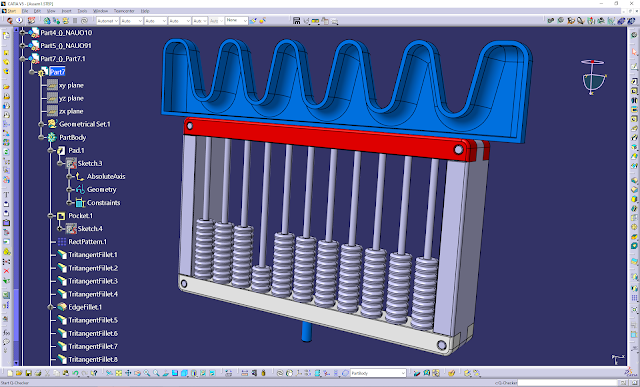
Initial Concept Packaging Study - DW Special One

Abacuses evolved in various forms at different times and places. But all share certain basic characteristics: movable markers arranged in vertical or horizontal columns, with different rows representing different values (ones, fives, tens, etc.).


Moving the markers “activates” them, creating different combination's of values.

The Electronic Age elbowed out the Mechanical Age in the 1960s. Calculator manufacturers had to adapt or perish. Electronics firms not previously in the calculator business saw this transition as a chance to compete on a newly level field. 
 
Competition fuelled innovation. By the late 1960s, desktop electronic calculators were lighter and quieter than their mechanical ancestors. 

Not necessarily better for every job…but bursting with potential....

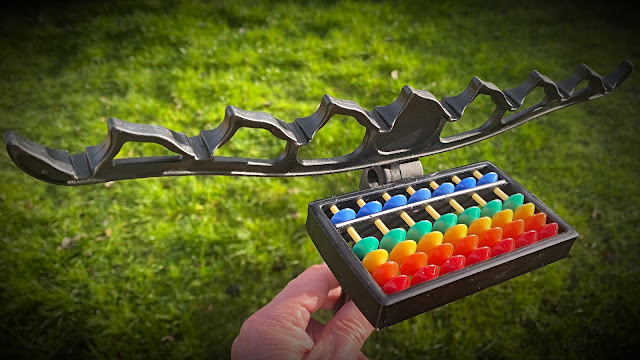
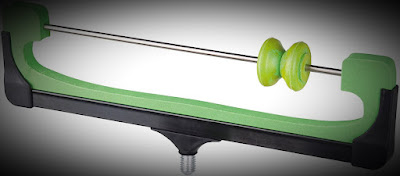
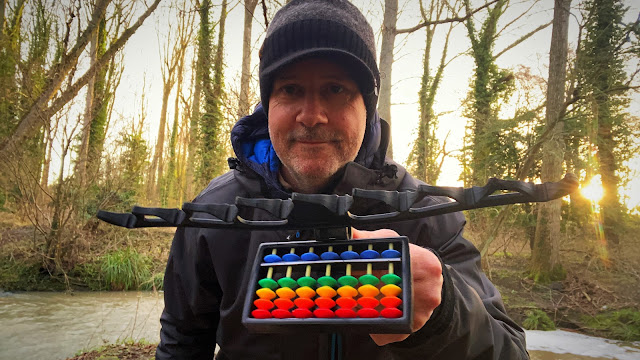
Mechanical is where it's at you see, but the current offerings on the market fall flat with the fish numbers caught these days. So Mavers sliding armrest gave me inspiration when devising the abacus armrest where it means there are no issues running out of digits as it will never be encountered.


After the initial concept was created the DW Special Two, the working prototype was designed, made, tested and developed. The outcome well.... 

....soon to be in the pound shop near you, fill your boots !!!!
Related Posts Plugin for WordPress, Blogger...