Friday, 20 January 2023

The Tiny River Alne - Baskins and Bathythermographs

Small stream fishing and it's likely residents I'm well conversed with now, and more recently I've been playing round with a scaled down helicopter rig. You see when the water is well up or very well coloured and a float cannot be used, (which I prefer) I'd usually use a link ledger set-up or a running feeder set-up, but often missed bites got me looking at rigs to increase my hook-ups.

A helicopter rig isn't new, and when fishing large lakes and gravel pits for specimen roach, the tangle free approach and self-hooking ability often when anglers are sat in their bivi's. Heavy bobbins and bait runners, feeder full of maggots, sit back and get the Ridge Monkey sandwich toaster on.  
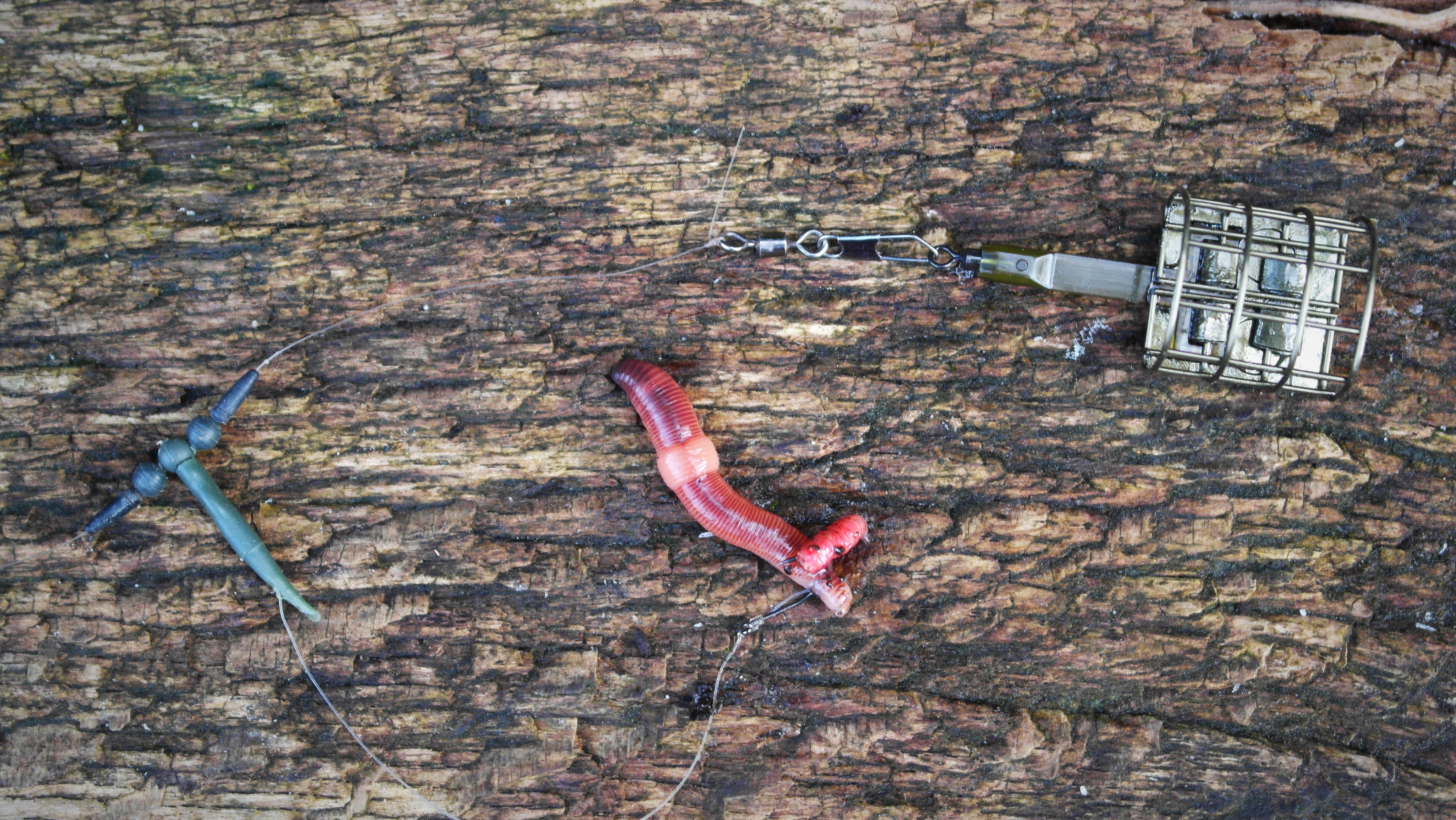

Bites on this set-up from 8 ounce dace and roach and and kamikaze trout using a stiffer quivertip then I usually (carbon not glass) use was very encouraging indeed. You see George had been having some lovely specimen roach on the Leam using a similar approach with a 10g feeder.

This Drennan micro jobby is more Tom Daley than Peter Kay when it enters the water and when fishing small rivers like this, less belly flops the better really as not to disturb the swim. 

George Burtons River Leam Big Roach Rig

The problem is the Leam is now home to some 4lb chub and scaling down can certainly have it's disadvantages, where any decent chub would quite easily pull the jumper over your head and provide some unwanted kidney punches and a middle fin when the hook-link parted or the hook-pulled. My set-up I tried successfully on the tiny stream was a halfway house as it uses 5lb mainline and 4lb on the short hook link. 

As I said I prefer to use a float when fishing small rivers but when coloured and especially when its barely above freezing those hands can be places in the chest pockets and only need to be removed when needed. 

Now In years gone by, probably not so much now, some rivers anglers are content just to fish. Others fish only for roach. A few set out deliberately to catch specimens. Sometimes their decision is arrived at after a natural progression from small roach to large ones and then, finally, to specimens. 

Sometimes the change of attitude is brought about by a happy combination of luck and timing which results in the angler catching bigger roach than he ever before thought existed in his river. 
He is often surprised amazed, even. But from that moment on, he is never quite the same again. He will fish with a new awareness, an intenser kind of expectation. He may even, in time, become a dedicated specimen hunter - a man apart; a different breed of river angler altogether.


Roach of specimen size are not caught easily. Many river anglers fish their whole lives through and never catch one. It may be that, in some cases, very few specimen-sized roach are to be found in a particular river. In just a few, there are many such roach. In most rivers nowadays with pollution and predation, they are not common. Any roach over a pound in weight is a good fish, it may even be a specimen for the water in which it was caught. 

Roach over a pound and a half in weight are very good fish, over two pounds, they are specimens in every sense of the word, and over three pounds, they are truly fabulous fish by any standards. Finding and catching roach of this class can be a frustrating business. The very uniformity of the average river and often its lack of truly recognizable swims can be baffling. 


Where can the angler start to look for them? And more important still, if he succeeds in finding them, how can he single out specimens from the lesser fish and catch them? The task is certainly difficult, but not impossible. The easiest and most obvious way is to look for them. 

In rivers that are very clear, location by observation is possible; but it takes time, stealth, keen eyes and a lot of patience. The angler who is habitually noisy in his approach and who always precedes his fishing by bombarding the swim with groundbait will seldom catch big roach. Now prevailing conditions can either hinder or help his efforts. Like many that target specimen fish it is best to fish early and late in the day, and preferably with the sun thinly veiled by cloud. Glare on the water makes fish spotting difficult in clear water without polarised sunglasses.  


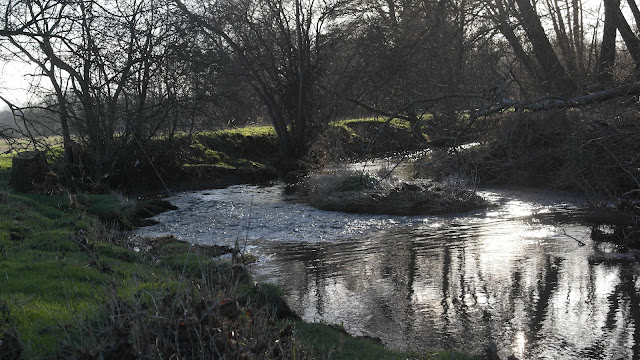
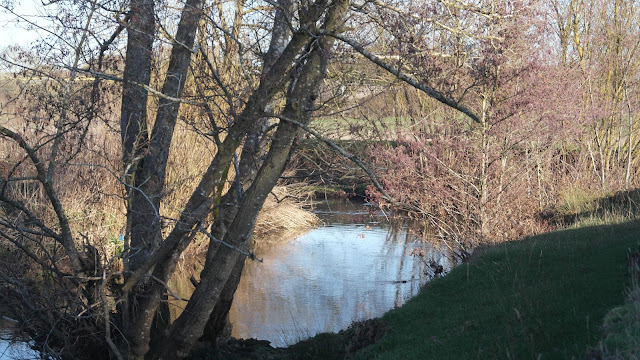
Anyway, another rig reccy this so I decided to head down to a stretch of the Alne I'd only fished once before. The word from the fellow bank dwellers that had fished this stretch has said "where the heck are all the bigger fish ?"
 
But as a seasoned Alne angler those bigger fish don't show as regularly as the Warwickshire Stour for example. In the height of the summer in places this river is a mere dribble but in the winter when the levels are boosted often then the bigger fish can be found. 

Big baits seem to be the key, in-fact I can remember a cracking session on the Alne where lobworms and size 6 hook did the business, with some nice chub and caught. The bigger chub I caught on the Alne over the years >3lb all came to either a Salmo Hornet or matchbox sized pieces of bread. if I recall.  

For this session though it was out with the worms and maggots where I'd drop in to any likely looking fish holding spot(s) to try and get a bite or two. 


The problem was evident on the first drop of the worm and maggot cocktail, yeap minnows and lots of them. The were literally on the bait within seconds and often on the drop. The tell-tale nonstop tapping and knocking of the quiver tip when they hooked themselves.

Some swims looked perfect for a bite, those swims where a much deeper area was quite clearly evident and yet oddly those swims seemed devoid of fish, hmmmmm very indeed. Swim after swim the same outcome when eventually a proper full round a decent fish was on.


Only a small dace and sadly that was about the best of the action and oddly it came from underneath a pretty stiff raft. The Alne in my experience is a very moody river though and often the best sessions I've had have been when its chocolate brown and motoring through. 

Still the rig did the business and that was all that matters I suppose but I'm not likely to come back here any time soon. Well I say that, I'm sure the Salmo hornet might have been the way to go because the water was much clearer than I thought it would be.


It was very pleasant in the sun but as soon as that went behind the trees it was very chilly indeed. The water temperature was only 4 degrees as well, so maybe the fish were sulking because of that.

This stretch has far more footfall than I'm used ( a couple of dog walkers and 3 other anglers) but I'm sure there are some nice fish to be caught here, like the other stretch I fish further downstream, I just need to fish it on a good day. 

Warwickshire Avon - Snorters and Snobocracy

When I received a scarf for Christmas from the company I work for a couple of years ago, I thought someone had forgotten to take the security tag off. A quick google of the designer John Sterner (never heard of him) theses scarfs don't come cheap, but no I was wrong, as it turns out the bright yellow tag is part of the design apparently.

Yeah, all very odd to me, but then having worked with many car designers over the years, these sort of things are not unexpected. I'm not a scarf man, but anything to keep me warm in these conditions is most wanted I must admit. Apart from my fingers from time to time, I've got all the gear now and cold doesn't both me any more. I'm just hoping Sam, my fishing partner in crime is up for a dangle soon, because I've missed my little fishing buddy I must admit. 


With the rivers been up and in flood for such a long time now, needs must and it's just me fishing at the minute. Now there is something about a stretch of turbulent water that attracts spectators, but though many will stand and stare, not so many will think of fishing where the water is really rushing along. Perhaps they think it unfishable, perhaps they think it would not be worth fishing anyway, very often they would be wrong on both counts.

You see for artificial sluices and the like, it is rare to find a water so uniformly fast that there are no fish in it, there are always irregularities, large or small, on the bed or in the bank of the river, which deflect the main force of the current and create sheltered lies.


Sometimes, of course, there are very obvious likely spots where an obstruction of some size, and the division of the current above and below it, are visible at the surface, sometimes one can deduce the presence of irregularities in the shape of the bed by noting the pattern of the surface flow. The less turbulent areas can hold a surprising number of fish, and there are almost always lots of lies which hold a fish or two- behind boulders, bits of weed, sunken branches, and so on.

If the shelter was not there, there would be no fish. They are not given to roaming about such water in search of their food, continually battling against current. They prefer to wait for something to come to them. They may sometimes move up-current to intercept something, but they will not move far across the current. 
 
This is not the type of water for any who seek restful contemplation, it means hard and continuous fishing. A stationary leger, unless it brings an immediate response, is not very likely to bring a bite at all, for a matter of 6 ins. one way or the other can mean that the bait is anchored in water which never holds fish.

On the other hand, a leger rig which is accurately weighted to suit the current will roll in the under- water eddies, very often to rest of its own accord where the pressure of current is reduced the very places where fish will most likely be. 

In some conditions there can be a heavy but varying drag on the line, this causes excessive bowing, makes bite detection very difficult and he drags the bait about the water too quickly. I find it best to fish, as nearly as possible, upstream, holding the rod high to reduce the amount of line in the water. 

This means that fast water can be fished without using a forbiddingly heavy lead. Occasionally, even in very turbulent water, little lead is needed. Though the water at the surface may be swirling wildly below a fall for instance underneath it may be quite steady, often with a nice, easy back current. Such places can, in fact, sometimes be fished perfectly well with no lead at all. 

One simply has to find out by trial and error what is really necessary, bearing in mind that to vary the length or direction of the cast by a yard or so may call for a drastic adjustment to the weighting of the tackle. In turbulent water the bites are liable to vary from a tiny pluck to a rod-bending heave, and there'll be slack-line bites too. 


The only safe course is to strike at anything which resembles a bite. This way you will inevitably strike at the knocks of weed and debris but you will also strike the real bites, as well. To attempt to differentiate between the two is to miss a lot of bites, unless you are much better at it than I am.

In general the larger baits are to be preferred, even if on other parts of the water small baits are generally used. Perhaps the speed of the water and the short time the bait is in view has something to do with this. There is very little water which is altogether too fast for fish, and if there are fish present there is a way of getting them out. It is rarely easy fishing; it may demand a drastic revision of tackle and methods; but it is undoubtedly fascinating, always challenging, and sometimes very rewarding. And who can ask for more than that?


Thankfully as the graph shows above, with the rain finally letting up the rivers are dropping nicely. It's still pretty nippy mind you with the daytime temperatures barley above freezing but at least that fishing fix can be had by choice, and not dictated to by the levels. 

For this post work short session the stretch of convenience was chosen to try and winkle out a chub at dusk which seems to be the time they are on it here. With a little colour in the water still I was hoping they would be confident as well, after not knowing what the heck is going on with the rivers being all over the place. These are chub after all, their wanton gluttony fear no angler. 


So yes it was out with the bread naturally, a veritable Chub catcher if there ever was one !!!

Before settling in behind the quiver rod in to dark though it was out with the trotting gear with some bread mash as feed to try and see if a moving bait would get them out from their lairs. 

Bread like no other bait really, well maybe maggots get them in a frenzy when they are in the mood, when especially in the summer surface fishing with bread they cannot resist the white stuff, a little like the cocaine snorters from Scotland (Scotland has the highest level of cocaine consumption in the world), they need their fix. 


I don't mind fishing in the dark, but to be honest I'd much rather fish in the daylight hours but with work commitments I've got no choice in the winter months if I want to get out. After forty minutes or so trotting a float without a bite I went to fish the two pre-primed swims, what I didn't expect was three proper pull rounds over the quiver I had nothing to show for it.

Those bites came at dusk and the last bite that I missed the fish felt the point of the hook. I was using my AD John Wilson quiver rod and to be honest the tips are a little cumbersome, I could have used my TFG River and Stream set-up that is far daintier in comparison, I rarely miss bites on that because there is no resistance whatsoever. 


Anyway, that swim went dead so it was on to the next one, after half an hour, nada, so on to the last swim I'd fish. The ground by this time was rock solid with the air temperature -1.

I was getting ready to get the gear in the car when after a couple of sharp taps the tip went all the way round and a fish was on. Nothing like what swims here sadly judging by the fight it was giving me, so when the 2lber surfaced I teased it in to the margins and unhooked it in the water. And that was that, no more bites sadly and after 2 and a half hours, not much to show for it. 

Sunday, 15 January 2023

Small Brook Fishing Pt.23 - Rubbers Ducks and Rumfustians

With the local rivers afflicted with turbid, torrent and turmoil many flowing water anglers I'm sure will be taking that well deserved lie in, or looking for that fishing fix on stillwaters and canals.

But for me this is where little side streams and brooks come in to play because so many of these are overlooked forgot waterways are a trip in to the unknown and offer the angler something different than the humdrum. Dace in-particular I've found grow to a decent size in the streams I fish, and when the levels are up, those slack and eddies hold fish where they quite rightly keep out of the mosh pit.  


Now dace are bright, graceful, slender little fish, which often find their way into the roach-fisher's creel. In colour they are almost entirely silvery, and the fins lack that tinge of red which is noticeable in the chub and the roach. 

They are easily distinguished from a small chub by the anal fin, which in the dace is almost colourless, and has a concave edge, but in the chub pink, with a rounded or convex edge. The dace is common to most rivers containing coarse fish, and is frequently found in trout streams, to the detriment of the trout.


Some swims hold nothing but trout I've found, and some all the species, roach can be hard to track down but stumble upon a swim with one, there are usually plenty of bites to be had.

I've never seen another angler on this one, well apart from Sam "still a bit cold for fishing Daddy" and these sort of conditions are perfect to get a few bites. I prefer to use a float set-up generally but when it's as high as this a scaled down helicopter rig with a tiny feeder is the tried and trusted approach I've used.

Bites can often come almost instantly and unlike a bigger river where I'd give a swim more time, 5-10 minutes in each likely holding spot is more than enough I've found.

If the stream contains trout like this one does some of the bites really are quite ridiculous, and the mechanics of the helicopter rig means they often hook themselves with the weight of the small feeder.

They are predators after all so I'd imagine they are smash and grabbers underwater hence when that quiver tip jumps in to life at an alarming rate you generally know what is it, and no, it won't be a bullhead. 

For this session it was the dace I was after but I knew especially with the baits I was using, trout would certainly come in to play, where even in coloured water they would feed without an issue. 

Now as the dace swims as often in mid-water, or close to the surface, as on the bottom, it is not as necessary to fish as near the bottom as we should if angling for roach. 

Dace generally haunt swifter streams than do roach, so the float-tackle has to be heavier shotted than is usual in roach swims. Dace are sharp biters too, and the angler should strike quickly on seeing a movement of the float.

The two favourite baits for these fish are maggots and worms. Caddis baits are good, and In the late summer and autumn a lobworm will take the largest fish. I once baited up a very quiet, deep corner on the Warwickshire Avon  for perch, and my baiting partly resulted in a  half a dozen fine stripeys. 


During that morning I was bothered by some fish which kept taking the float under, but which I could not hook. An examination of my bait showed me that the fish, whatever they were, only seemed to touch the head of the worm, which was, as usual, up the shank of the hook, so I threaded the next worm on with the tail up the shank, and the head over the point. 

I then hooked a fish at nearly every bite, and soon had more than a dozen of the finest dace I caught that year. The incident enlightened me considerably as to why one has so many bites from dace when barbel fishing without any getting hooked, and since then I have respectively found the dace prefer the head to the tail of the lobworm.  


Anyway to this session, I was scratching round for bites at first but eventually the bites started to come frequently with one particular swim a bit of a revelation because it was full of small trout. After five of them and one much bigger one I could have stayed there longer I suppose, but it was the dace I was after and the trout don't mess around with the bait, a bit like a perch really, straight down the gullet and a disgorger is needed. 

They key for this morning was to fish within the flow, but not any old flow, but flow where there was no boiling whatsoever, the kind of flow you want in a rubber duck race. 


With the helicopter set-up the bites are still pretty bold but often I've found it only needs some reasonable pulls where it definitely worth striking.

The tell-tale side to side motion when playing the fish you know you have a silver dart on the end. They always seem to be plump on this stream so they must have plenty of food. At first a few small'uns but then out of the blue a bigger fish that went a pinkie under 8 ounces on the scales.(yes I do weigh them 😁)


A cracking fish from a stream which is completely overlooked by the modern angler. I do wonder why though because Sam and I do love this kind of fishing, 

Still it's nice to have this waterway to myself really. Much of it is untapped too, so next time I might venture up to the upper reaches to see if I'm missing a trick so to speak. I'm sure there are more surprises to be had, and that why I love fishing them. 
Related Posts Plugin for WordPress, Blogger...